Formula One Lotus photographed with intentional panning motion blur
Intentional pan: 1/100 sec · 250mm · ISO 200. Photo by John Chapman (Pyrope), CC BY-SA 3.0 via Wikimedia Commons.
F1 settings

Freeze it or pan it. Pick the photograph first.

A sharp frozen car and a good motion pan need very different shutter speeds. Decide which look you want before changing autofocus settings—or buying another camera.

See the difference →
Two successful photographs

Sharp action and motion blur can both be right.

Formula One McLaren photographed sharply at one one-thousandth of a second
FREEZE1/1000 sec

The car is the sharp priority. If this is the look you want and the car is blurred, raise shutter speed before changing everything else.

300mm · f/10 · ISO 500. Renzopaso / Artes Max, CC BY-SA 2.0.
Formula One Lotus photographed with panning at one one-hundredth of a second
PAN1/100 sec

The background blur is deliberate. If the whole car dissolves too, move to a faster shutter and rebuild a smoother follow-through.

250mm · f/16 · ISO 200. John Chapman (Pyrope), CC BY-SA 3.0.
If the shot is soft

Look at what is sharp before blaming the camera.

The frame usually gives you a useful clue. Change one thing at a time.

Background sharp, car blurredLikely subject motion. Use a faster shutter for a freeze.
Fence or background sharp, car softFocus may be on the wrong plane. Acquire the car earlier and simplify the AF area.
Whole pan smearedYour shutter is too slow for your current tracking consistency. Move faster, then work back down.
Car sharp but tinyThat is a framing/reach problem, not a shutter-speed problem.
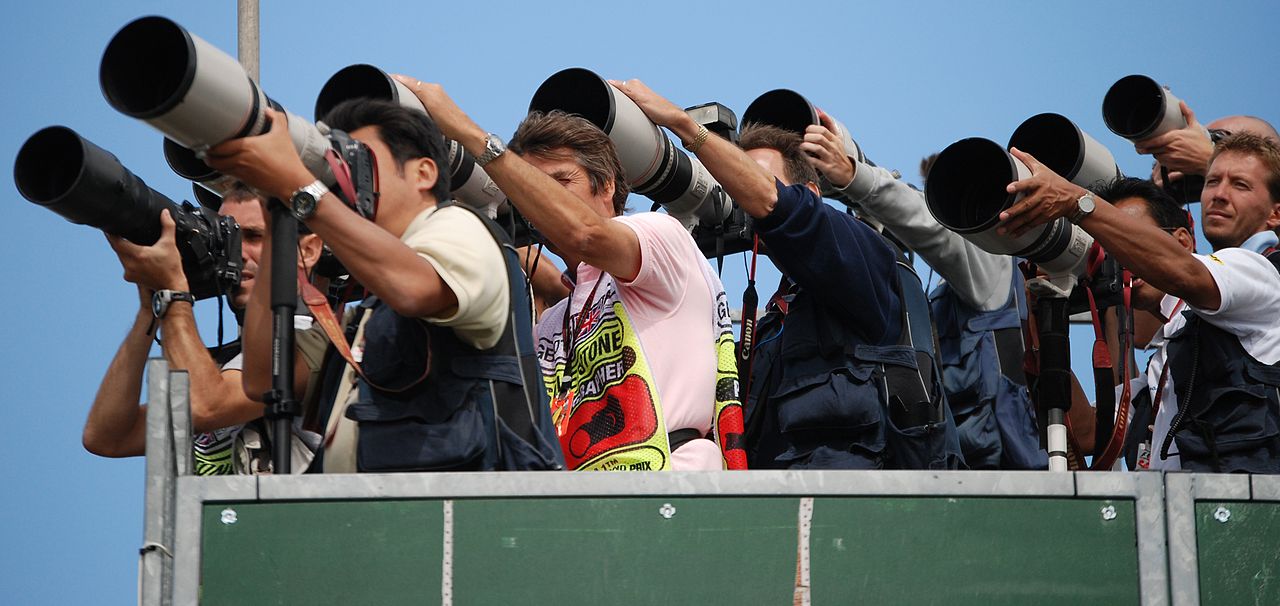
Formula One photographers using long telephoto lenses
Motorsport photography demands tracking as much as equipment. Photo by Ann64, CC BY-SA 2.0.
Starting settings

Keep the first setup simple.

FREEZE

Start around 1/1000 sec.

Move toward 1/1600 or 1/2000 if the car still shows unwanted subject motion, especially on a close fast crossing.

  • Continuous AF / Servo / AF-C
  • Short controlled bursts
  • Let ISO rise before sacrificing the shutter the shot needs
PAN

Start around 1/250 sec.

Once your tracking is repeatable, try 1/125 and then slower speeds for stronger background motion.

  • Acquire before the ideal frame
  • Follow through after the burst
  • Judge sharpness on the car, not the background
AUTOFOCUS

Use focus that keeps updating.

Keep the AF area simple enough that you can hold it on the car. Vehicle recognition can help on supported bodies, but it is not a substitute for keeping the subject in the active area.

  • Acquire early
  • Use continuous focus
  • Test the camera's tracking behaviour before race day

Useful manufacturer references: Nikon panning guidance · Sony motorsport focus guide.

f/2.8
Night race

A bright circuit can still be dark at 1/1000.

Set the shutter speed the photograph requires, open the aperture as appropriate, and let ISO rise to hold exposure. If you already have enough reach, an f/2.8 telephoto can be a more useful purchase than a longer but slower zoom.

If artificial lighting creates banding, test anti-flicker or high-frequency-flicker settings and different shutter modes on the actual camera before race day.

Shooting through a fence

Get close to the fence without crossing the barrier.

Where safely and legally permitted, moving the front of the lens closer to the fence, focusing well beyond it, and using a wider aperture can make the fence less dominant. Never put equipment through a safety barrier or enter a restricted area for a cleaner frame.

Still missing the shot after the settings are right?

If the car is too small, look at reach. If the framing is good but night exposure is the problem, compare the f/2.8 path. The Motorsport & F1 page has the current Altech product choices.

Back to camera & lens picks